Fardeen Ferdous
Where does the river stand on this beautiful earth? You’re right—it flows deep within the heart of the all-embracing soil, beneath the blue sky. In Bangla, it means Neel Akasher Niche—which is also the title of a Bengali film released in 1959 in Kolkata. In this film, lyricist Gauriprasanna Mazumdar and the legendary singer Hemanta Mukhopadhyay created a song that deepened the spiritual bond between man and river. Perhaps there is not a single Bengali who has not heard this immortal melody: “O nodire, ekti kotha shudhai shudhu tomare.” This song means: O river, I ask you just one question—tell me, where is your homeland? Do you never come to rest? Are you unbound? Are you forever homeless? Now I see you ebbing away, and again swelling with the tide.
We have all read novels such as Titas Ekti Nodir Naam (A River Called Titas) by Adwaita Mallabarman, Padma Nodir Majhi (Boatman of the Padma) by Manik Bandopadhyay, Hasuli Baker Upokotha (Legend of Hansuli Turn) by Tarashankar Bandopadhyay, Ganga by Samaresh Basu, and Kando Nodi Kando (Cry, O River, Cry) by Syed Waliullah. Each of these works tells a tender, timeless story of the relationship between people and the river.
More than a century ago, Rabindranath Tagore described the river’s rhythm in his Chhinnapatra (Letters from Chhinnapatra)—a picture that, in fragments, still holds true today: “Down to the river is a rough, winding landing (ghat) where someone is washing clothes, someone bathing, someone scrubbing utensils. A shy young woman, lifting her veil slightly with two fingers, peers curiously at the landlord as she carries a water pot on her hip. By her knees, a freshly bathed, glistening child stares wide-eyed at the stranger who is the author of these letters. Boats are moored at the bank, and an abandoned dinghy lies half-submerged, waiting to be retrieved.”
Tagore painted a similar image in his well-known poem Amader Chhoto Nodi (Our Little River): "Our little river winds and bends, In summer months its shallows end. Cattle wade and carts roll through, Its banks are high, its slopes steep too." In another poem, Nodi (The River), the poet transforms the river into a vessel of thought and self-awareness: "O tell me, dost thou know, Why the waters dance and flow? Day and night they move and play— From whom have they learnt their way?"
At the very core of Bengali literature lies the river. Sometimes she is the tender mother, sometimes the fierce destroyer, and at other times, the silent symbol of introspection. Just as Bengal’s geography is riverine, so too does its literature flow with the consciousness of its rivers. From the ancient Pala and Mangal epics to Rabindranath, Jibanananda Das, and contemporary writers—all have nurtured an inseparable bond with the river.
In early Bengali verse, the river appeared as a meeting point of nature and belief. In Chandimangal or Manasamangal, the river was not merely a geographical element but also a vessel of divine blessing—or wrath. Crossing the river, the bhatiyali songs, the rituals of Manasa Puja—all describe a lifeworld shaped around the river. In folk culture, the river embodies livelihood, love, longing, and uncertainty.
Manik Bandopadhyay captured this poignantly in Padma Nodir Majhi (Boatman of the Padma): “God dwells in the genteel quarters; here He is not to be found.” Those very people of the 'genteel quarters’, ever claiming divine favour, are the ones dissecting and exploiting the river—turning it into a commodity. And those who cannot ’find God here’ are the ones suffering most from this desecration.
Once upon a time, Bangladesh was known as the Land of Rivers—Nodimatrik Desh. The phrase “The river is Bangladesh” was not merely a geographical truth but a cultural identity. The Padma, Meghna, Jamuna and Brahmaputra, along with hundreds of others, shaped the nation’s agriculture, fisheries, transport and daily life. But now, those rivers are gasping for breath—their flow stilled, their beds silted, their waters blackened. Encroachment, pollution, climate change, and administrative apathy have turned Bangladesh’s rivers into dying arteries.
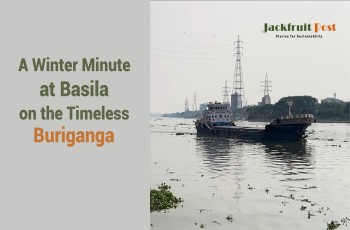
The rivers encircling Dhaka—Buriganga, Turag, Balu and Shitalakkhya—once pulsed with life and commerce. Today, they reek of stench and toxicity. Industrial waste, tannery effluents and plastic debris pour into them by the thousands of tones every day. The pollution is so extreme that, in many places, the water no longer resembles water at all—it has turned into thick, black sludge.
Though several projects have been initiated to revive the Buriganga, the results remain disappointing. New constructions rise on the riverbanks, and land-filling continues to devour the waterways. According to the National River Commission, nearly 50,000 river grabbers have been identified across the country, yet punitive action remains rare.
As noted by Muhammad Monir Hossain, Chairman of the River Foundation, there are 19 rivers in Gazipur near Dhaka: Turag, Chilai, Labanadaha, Balu, Shitalakkhya, Old Brahmaputra, Khiro, Paruli, Suti, Banar, Nagda, Louhajang, Bansi, Saldha, Sutiya, Gollar, Naljuri, and Konai—the actual number may be even higher. Among these, Turag, Labanadaha, Chilai and Bansi are the most polluted. In the Turag alone, 296 pollution sources have been identified; in Labanadaha, 145; and in Chilai, 56. These include factories, markets and domestic waste outlets. Unplanned urbanization, industrialization, sand extraction and neglected river management have all disrupted the natural flow.
The crisis is not merely local—it is transboundary. India’s upstream dams and barrages have severely obstructed the natural flow of rivers entering Bangladesh. The Ganges, Teesta, Dharla, Dudhkumar and Mahananda now run almost dry during the dry season, yet swell into devastating floods in the monsoon. This erratic rhythm is crippling agriculture, fisheries and navigation. Sedimentation is choking the riverbeds, and smaller rivers are turning into marshes.
The country’s river-based livelihoods—boatmen, fishermen, dockworkers and boat builders—are vanishing, and with them, a centuries-old way of life. Rivers are more than aquatic systems—they are the lifeblood of civilization itself. With their demise, native fish like hilsa, rui, boal and prawn are disappearing. The fertile lands by the rivers are losing productivity, and rural economies are faltering.
With the rivers, Bangladesh is also losing its culture and folklore—boat races, songs of the monsoon, river festivals and the countless tales that once flowed with the current. A living civilization is silently fading away.
Policies exist for river conservation, but implementation remains almost absent. The River Commission, Department of Environment, Water Development Board and district administrations all pass the burden from one to another. Projects begin and die in files. When eviction drives take place, encroachers soon return, shielded by political patronage. River grabbing has become a well-known open secret.
Yet by law, rivers are public property—belonging to all. In reality, however, those in power—the same ‘genteel quarters’ again—act as their private owners. Saving the rivers is not merely an act of environmental protection—it is a battle for human survival. We must:
- Adopt an integrated river management plan with databases, maps and maintenance schemes for every river
- Enforce strict penalties against encroachers by strengthening legal frameworks
- Make effluent treatment plants mandatory for all industries
- Pursue active diplomacy to ensure fair water sharing of transboundary rivers
Engage local communities and civil society in river protection—for rivers are not just government projects; they are public rights
Bangladesh’s rivers have become symbols of our collective guilt. The same waters that once gave this land life now await death in silence. To lose a river is not merely to lose a body of water—it is to lose a nation’s soul. The time has come for a new social movement: Save the Rivers, Save the Country must be our shared call.
In Bengali literature, the river has been at once poetry, lament and crimson history. It is not merely an element of nature—it lies at the heart of Bengal’s identity. The river embodies geography, memory, love, struggle and existence itself. In Tagore’s meditation, in Jibanananda’s nostalgia, in Manik’s realism—the river flows eternally through Bengal. We are but the humble stewards of this eternal flow.
[Fardeen Ferdous is an experienced mainstream journalist, actively working in the field, with a history of notable contributions to citizen journalism.]