Nano-fertilizers can make Bangladesh
agriculture more sustainable
With the rising need for sustainable agricultural practices,
nano-fertilizers have become an emerging
agricultural technology designed to reduce reliance on conventional chemical
fertilizers and lower production costs. The
use of nano fertilizers can
significantly reduce the environmental impact of farming. By improving nutrient
uptake and reducing wastage, nano
fertilizers lower the risk of nutrient run-off into water
bodies, which is a common issue with conventional fertilizers. This can help
reduce soil and water pollution,
contributing to a healthier environment.
Nano-fertilizers are
fertilizers formulated at the nanoscale, containing essential nutrients like
nitrogen, phosphorus, and potassium, as well as micronutrients such as zinc,
iron, and boron. "Nano" refers to a scale of 1 to 100 nanometers.
While conventional fertilizer granules are visible to the naked eye,
nano-fertilizer particles are so minute that up to 500 million of them can be
mixed into a single liter of water.
According to a BBC bangla
report published on 12th September 2026, Agricultural scientists are
now turning to "nano-fertilizers" to avert a future fertilizer
crisis—an innovation being hailed as the fourth revolution in global
agriculture.
Scientists
highlight three key characteristics of nano-fertilizers: Their small size
provides a significantly larger surface area for contact with crop leaves or
roots. The nano-particles are encapsulated in polymers or clay, allowing the
fertilizer to gradually nourish the plant over a period of 40 to 50 days; a single
spray is sufficient. When sprayed on leaves, nano-fertilizers enter the plant
directly through the stomata (pores); when applied to the soil, they are easily
absorbed by the roots.
Two of the most widely
discussed products in this category are Nano Urea and Nano DAP, which are
typically available in liquid form in bottles. Many agricultural scientists
note that, by rough estimate, 500 ml of Nano Urea can provide an amount of
nitrogen equivalent to a full 45-kilogram sack of conventional urea.
Agricultural scientists
believe that nano-fertilizers could be a game-changer for a country like
Bangladesh, which faces land scarcity, a high population density, and a
reliance on fertilizer subsidies. They state that using such fertilizers could
potentially increase agricultural production by up to four times.
While crops can absorb
only 30 to 40 percent of conventional urea—with the remaining 60 percent lost
to evaporation or washed away by rain—nano-fertilizers offer an efficiency or
crop-absorption rate of 70 to 80 percent. Consequently, less than half the
amount of fertilizer would be required to achieve the same yield, thereby
reducing the government's subsidy burden for fertilizer production or imports. Agricultural
and soil scientists also anticipate a reduction in the soil and water
degradation currently caused by the excessive use of urea.
The global trend of
using nano-fertilizers has gained some momentum since 2020, with most
applications involving liquid formulations. Additionally, research is underway
on biochar-coated urea—granular urea produced through a specialized
high-temperature process using sawdust.
Experts report that the
use of nano-fertilizers in agricultural production has already begun in various
countries around the world, including India and China. Currently,
India is leading the production and marketing of nano-urea. Indian Farmers
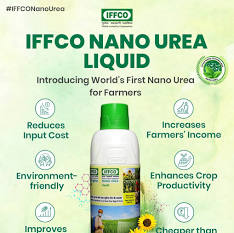
Fertiliser Cooperative Limited (IFFCO) launched the world's first nano-urea in June 2021, marking a breakthrough in sustainable
agriculture. By the end of 2024, the company aims to scale up annual production
to three billion bottles, equivalent to 13.5 million tonnes of conventional
urea. Nano-urea is already being exported to more than 25 countries, including
the United States, Brazil, Mexico, Sri Lanka, and Kenya.
In Bangladesh, an
international seminar on nanotechnology was held for the first time in 2012. Work
on applying nanotechnology to agriculture began shortly thereafter, a
development that was subsequently reflected in the National Agriculture Policy
formulated in 2018. This encompasses the adoption and expansion of
nano-fertilizers, nano-pesticides, and nano-sensors within the agricultural
sector.
However, despite being
included in national policies, the practical application of nanotechnology in
Bangladesh's agriculture has not yet materialized to any significant extent. Institutions
such as the Bangladesh Agricultural Research Institute (BARI), the Bangladesh
Rice Research Institute (BRRI), and the Bangladesh Institute of Nuclear
Agriculture (BINA) are conducting field trials on nano-urea and nano-zinc.
Agricultural scientists
note that nano-silicon and nano-zinc strengthen plant cells; consequently,
their use in the saline regions of southern Bangladesh could boost rice yields
by up to 15 percent. According to them, while farmers typically need to
broadcast urea three to four times a year, nano-urea requires only two spray
applications, saving both labor costs and time.
Furthermore, spraying
nano-zinc on wheat has increased yields by 8 to 12 percent, while spraying
nano-boron on maize helps produce well-nourished kernels. A preliminary survey
indicates that farmers have been able to reduce pesticide and fertilizer costs
by up to 30 percent by applying nano-sprays to crops such as tomatoes,
potatoes, chili peppers, and mangoes.
Experts state that it
is possible to reduce the carbon footprint associated with the production and
transportation of nano-fertilizers by up to 80 percent; additionally, nitrous
oxide emissions are lower.
Nano-particles are so
minute that global research is currently underway to understand their long-term
impact on soil microorganisms and earthworms. It is also crucial to establish
"safe dosage levels" for these fertilizers to determine whether
excessive use could lead to the accumulation of toxins in the soil.
There are currently no
specific policies in Bangladesh governing nano-fertilizers. Experts emphasize
the need to determine appropriate application rates—specifically, the quantity
(in milliliters) and timing required for different crops.
Nano fertilizers are designed to be more sustainable. Since they reduce
nutrient wastage, they require less frequent application, leading to lower
costs and reduced reliance on chemical inputs. This makes nano fertilizers a more
cost-effective and environmentally friendly option for farmers.