In-Depth Analysis- Jackfruit Post
The interim government has revived a long-stalled project to restore the Shubhadhya Canal, marking a renewed effort to reclaim the vital waterway. Over the past two decades, multiple initiatives aimed at restoring the canal have been launched, only to be abandoned midway. While the latest push brings fresh hope, lingering doubts remain — will Shubhadhya Canal truly make a comeback this time?
The Shubhadhya Canal: A Vital Waterway in South Keraniganj
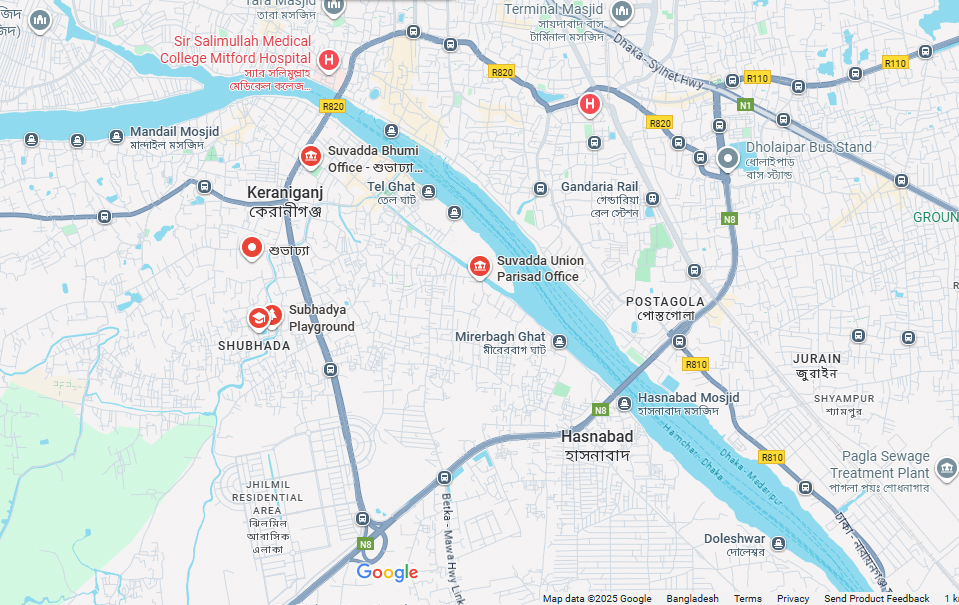
Flowing through the heart of South Keraniganj, just outside Dhaka, the Shubhadhya Canal serves as a crucial link between the Buriganga and Dhaleshwari rivers. Spanning a total length of seven kilometers, the canal originates from Char Kaliganj and flows through key areas including the Kaliganj Zila Parishad Market, eventually ending near the Rajendrapur Bazaar. This important waterway passes through two administrative unions—Shubhadhya and Teghoria—playing a significant role in the region's water management and local connectivity.
Once a Lifeline: The Glorious Past of Shubhadhya Canal
The Shubhadhya Canal, a historic waterway in Dhaka’s Keraniganj region, was once a vibrant and essential part of local life. Locals recall a time when the canal was bustling with activity—boats regularly navigated its waters, people fished for native species, and nearby farmlands relied on it for irrigation. Just 25 years ago, the water was so clean that residents used it for drinking.
Serving as the main source of potable water for nearly 50 villages in the Shubhadhya, Aganagar, and Teghoria unions, the canal also provided a vital livelihood for many families who depended on fishing. Large passenger and cargo boats used to traverse its length, making it a key transport route.
The canal was more than just functional—it was a hub of cultural tradition. Annual boat races were a much-anticipated event, drawing crowds and celebrating the region's deep connection to its waterways. For the local population, the Shubhadhya Canal was not just a body of water, but a lifeline woven into daily life and heritage.

Shubhadhya Canal on the Brink: Pollution and Encroachment Push Historic Waterway Toward Extinction
Once a vital lifeline for the communities of South Keraniganj, the Shubhadhya Canal is now facing an existential crisis due to widespread encroachment and severe pollution. Once seven kilometers long, the canal is now almost entirely clogged with solid waste, plastic, and polythene. In some areas, the canal has been filled to such an extent that people can walk across it.
From Charkaliganj to Golam Bazaar—a stretch of nearly three kilometers—the canal has been filled with indiscriminate dumping of plastic and mixed industrial waste. What was once a waterway now resembles an open dumping ground. This section, surrounded by hundreds of factories and shops, has completely lost its flow of water. Waste from these commercial establishments is directly discharged into the canal, turning it into a toxic channel. People now cross this part of the canal on foot, without the need for any bridge.
Upstream from North Shubhadhya to Chitakhola, sedimentation has filled the canal bed. Grass has even started to grow in these areas, indicating a complete loss of water flow. From Chitakhola to Rajendrapur, some excavation has been carried out and soil has been heaped along the banks. While water still collects in this section, it has no outlet, resulting in stagnant, lifeless pools.
Along the canal's banks, unauthorized markets and temporary structures have sprung up. Influential groups have built permanent shops and set up kitchen markets. Most vendors dispose of their garbage directly into the canal. Wastewater from nearby washing and dyeing factories has turned the canal's water pitch black due to chemical contamination.
Key areas like Charkaliganj, Kaliganj Bazaar, Jora Bridge, Naya Shubhadhya, Kadamtali, Charkutub, Jhaubari, Begunbari, and Golam Bazaar have all suffered severe environmental degradation. These locations are now choked with garment waste, household garbage, and leftover fabric scraps, erasing the canal’s existence from view.
From Kaliganj’s Jora Bridge to Koirbartypara, people have constructed houses by illegally occupying canal land. According to the Bangladesh Water Development Board (BWDB), there are 20 bridges over the Shubhadhya Canal. Some of these have been built encroaching on the canal itself, while others are so low that they block both water flow and boat movement.
Alarmingly, from the canal's origin at the Buriganga River in Dhaka to its end at the Mollarbazar point of the Dhaleshwari River, nearly 14 kilometers have been entirely filled in. What was once a thriving water route is now on the verge of disappearing altogether.
Unfulfilled Promises: A History of Failed Projects to Restore Shubhadhya Canal
Over the past two decades, multiple government agencies and local administrations have undertaken projects to restore the Shubhadhya Canal—once a vital waterway in Keraniganj. However, most of these initiatives have failed to deliver lasting results, plagued by inaction, poor implementation, or alleged corruption.
The Bangladesh Water Development Board (BWDB) implemented several projects between July 2013 and June 2017 aimed at re-excavating the canal and preserving its banks under the title: “Environmental Balance Restoration Through Re-excavation and Bank Protection of the Shubhadhya Canal (Shubhadhya to Aganagar)”. Though some physical work was completed, the efforts were not sustained.
In 2021, a modern engineering design was submitted for a 7-kilometer stretch of the canal—from Kaliganj Zila Parishad Market near Sadarghat to Rajendrapur, adjacent to the Dhaka Central Jail. The plan included widening the canal to 50–70 feet and transforming it into an aesthetic waterway. Despite its ambition, the project remains shelved.
|
Shubhadhya
Canal Restoration: |
|||
|
Year |
Authority |
Budget
Allocated (Taka) |
Actions |
|
2000 |
- |
1,728 crore |
Project
planned, but no work initiated |
|
2007 |
Caretaker
Government |
- |
186 illegal
structures demolished over 3 km; canal flow briefly restored |
|
2012 |
Keraniganj
Upazila Administration |
5.5 million |
Minor
initiatives; limited visible impact |
|
2013 |
BWDB |
Part of
multi-year |
Re-excavation
and bank protection from Shubhadhya to Aganagar. Partial implementation |
|
2015 |
Ministry of
Environment (Climate Change |
100 million |
Canal
re-excavation and embankment block work. Some illegal structures removed |
|
2016 |
Upazila Admin
– |
2 million |
Waste removed
from the canal |
|
2018 |
Bangladesh
Water Development Board |
100 million |
No visible
progress; allegations of embezzlement |
|
2021 |
- |
1,300 crore |
Proposal to
build aesthetic lake and paved walkways like Hatirjheel- but no execution. |
|
2023 |
- |
Initial: |
Work started
briefly but was halted; Fresh excavation budget approved later |
Despite multiple allocations amounting to thousands of crores over the years, very little progress has been made in restoring the Shubhadhya Canal. Initiatives often begin with enthusiasm but are soon mired in red tape, halted prematurely, or allegedly mismanaged. Meanwhile, the canal continues to suffer from encroachment and pollution, with its condition deteriorating further each year.
317 Crore Plan Targets Full Revival by 2026
After years of delay and failed initiatives, the government has finally launched a comprehensive plan to restore the severely degraded Shubhadhya Canal in Keraniganj. The project, with a budget of Tk 317.59 crore, will be implemented by the Bangladesh Water Development Board (BWDB) and executed by the 24 Engineering Construction Brigade of the Bangladesh Army.
The initiative aims to re-excavate the canal, construct embankments, build a 16-meter-wide walkway, introduce proper waste management systems, and restore the natural water flow. The project is scheduled to begin in June 2025 and is targeted for completion by June 30, 2026.
Obstacle: 20 Bridges Blocking Water Flow
According to BWDB, 20 bridges currently obstruct water flow through the canal and must be demolished or modified to restore connectivity. These include- Pargendaria Bridge, Khejurbagh Bridge, Charkaliganj Bridge, Ice Cream Factory Bridge, Murgipatti Bridge, Alam Market Bridge, Alam Market Jora Bridges, Charkutub Bridge, Kadamtoli Bridge, Jhaubari Bridge, Begunbari Bridge, Shamsur Pol, P.K. Roy School Bridge, Shubhadhya School Bridge, Shubhadhya Cremation Bridge, Aliapara Bridge, Paina Khalpar, Purahati Railway Bridge, Alam Market-1 Bridge and Alam Market-2 Bridge. BWDB states that these bridges, often built too low or without proper planning, have severely blocked water and boat movement.

The canal restoration project was officially inaugurated on August 26 by Home Affairs Advisor Jahangir Alam Chowdhury and Environment, Forest, and Climate Change Advisor Syeda Rizwana Hasan. The event marked a renewed commitment by the government to reclaim and revitalize the historic canal, which has long suffered from encroachment, pollution, and neglect.
Back in 2000, a grand restoration plan for the canal was approved with a massive budget of Tk 1,728 crore. However, this project was later shelved and reduced significantly in scope by subsequent governments. The current project draws from that earlier plan, repackaged under a smaller, more focused budget in its first phase.