Staff Correspondent - Jackfruit Post
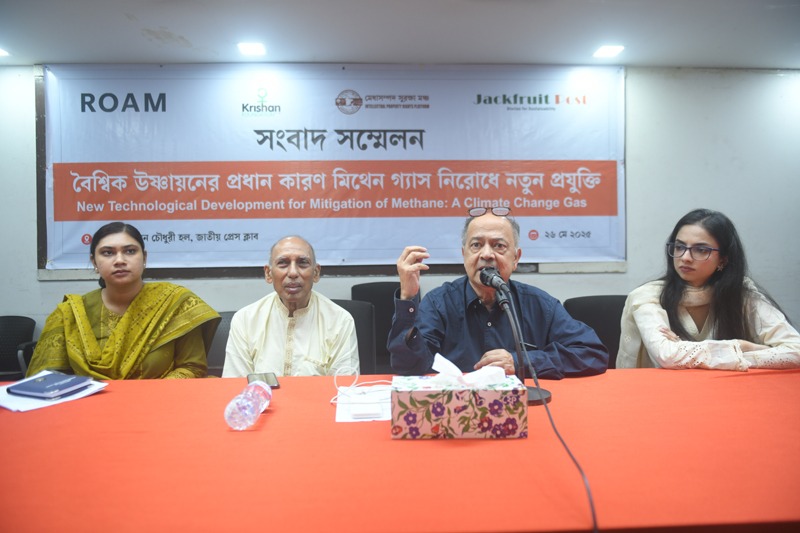
In a significant development in the fight against climate change, renowned genetic scientist Dr Abed Chaudhury held a press briefing today at the Jahur Hossain Chowdhury Hall of the National Press Club in Dhaka. The event, titled 'New Technological Development for Mitigation of Methane: A Climate Change Gas', was jointly organised by the Australian biotech company ROAM, Krishan Foundation, Medha Sompod Surokkha Mancha, and Jackfruit Post.
Addressing
a packed room of journalists and scientists, Dr Chaudhury highlighted the
alarming role methane gas plays in global warming, noting that a major source
is the digestive systems of ruminant animals such as cows, goats, and
buffaloes. These animals emit large amounts of methane during digestion—through
belching, respiration, and excretion. Globally, ruminants release around 100
million tons of methane every year. In Bangladesh alone, the livestock sector
produces methane emissions equivalent to approximately 30 million tons of
carbon dioxide annually.
“Even
during Eid-ul-Adha alone, around 50,000 cows are slaughtered in Bangladesh.
Recent research estimates that the total cattle population in the country may
exceed 25 million,” Dr Chaudhury stated.
He
added, “In countries like Australia, the Netherlands, and parts of Europe,
farmers cultivate seaweed—particularly red seaweed such as Asparagopsis—as cattle feed to reduce methane emissions. While
studies confirm its effectiveness, large-scale seaweed cultivation is not a
feasible option in Bangladesh. This challenge inspired me to seek out
alternative solutions.”
Representing
the Australian research organization Loam Bio, Dr Chaudhury presented a
groundbreaking discovery: a naturally occurring fungus capable of reducing
methane emissions in ruminants by up to 90%. The fungus, which requires no
genetic modification, has no negative health impact on animals. When mixed into
livestock feed as an additive, it significantly lowers methane output, offering
a natural and sustainable solution.
The
innovation, published in the Biotechnology
Reports journal in March 2025, has already generated considerable global
interest. On the strength of this research, a new startup ‘ROAM’ has been launched. The company’s business model enables
farmers to produce the fungus locally in small units. Dr Chaudhury also
announced that a major share of ROAM is now open to investors, with an $8
million investment opportunity currently available—something he believes could
greatly benefit Bangladeshi stakeholders.
The
press conference featured remarks from several prominent attendees, including
Shamsul Huda, founder of ALRD; Sifat Hossain Joya, scientist at the Bangladesh
Livestock Research Institute; and AKM Fahim Mashroor, CEO of Bdjobs.
“Carbon
trade opens up a new horizon for Bangladesh’s export sector. This could be a
significant chapter in our economy,” said Fahim Mashroor.